Telemetry Analysis Tool
For a coding assignment, I wanted to make a project that connects directly to what I love most. I’m currently developed a Python based driver improvement software designed to analyze on track or simulator data, in specific, cornering speed, throttle application, and braking behavior to generate clear, actionable tips to help drivers improve their lap times. The goal is to build a tool that I can use personally as I grow as a driver, while also creating something valuable for sim racers and motorsport enthusiasts.
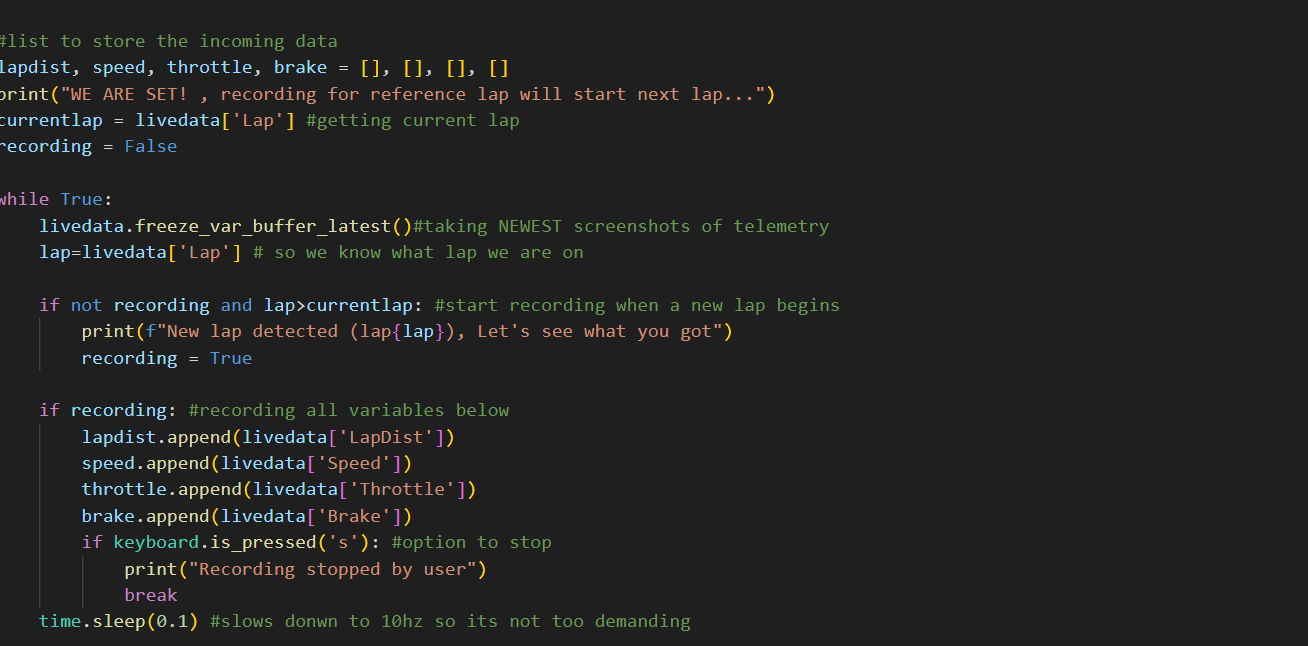
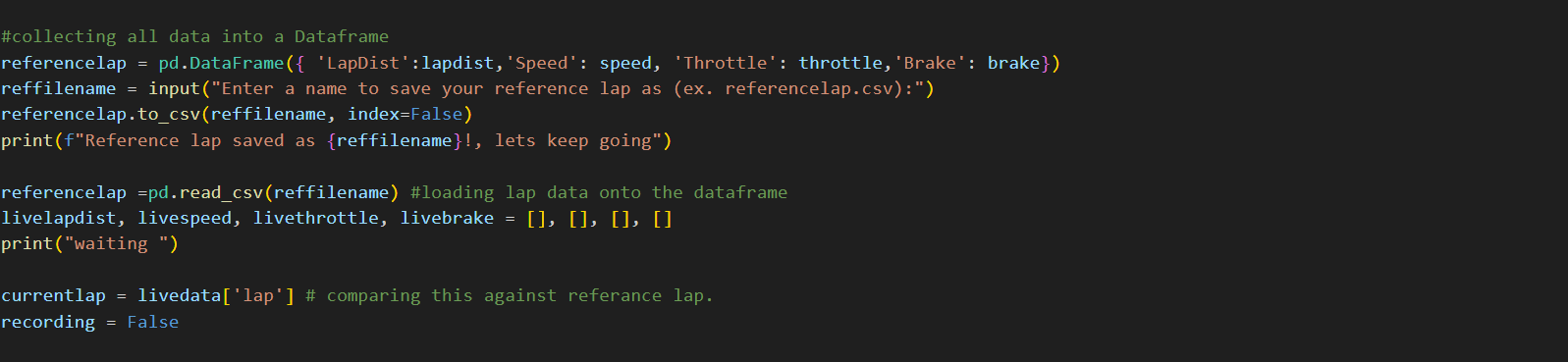
As I wrap up this project I want to reflect about the process and the result is a motorsport-focused data analysis tool designed to help drivers improve their lap times using real-time telemetry. Using the iRacing SDK, the program records key performance metrics—such as speed, throttle input, brake pressure, and distance around the lap—and stores them as a reference lap. This reference lap acts as a benchmark representing an ideal or optimal performance. The code continuously listens for a new lap to begin, captures telemetry with high frequency, and organizes the collected data into structured Pandas Data Frames for easy comparison and later analysis.
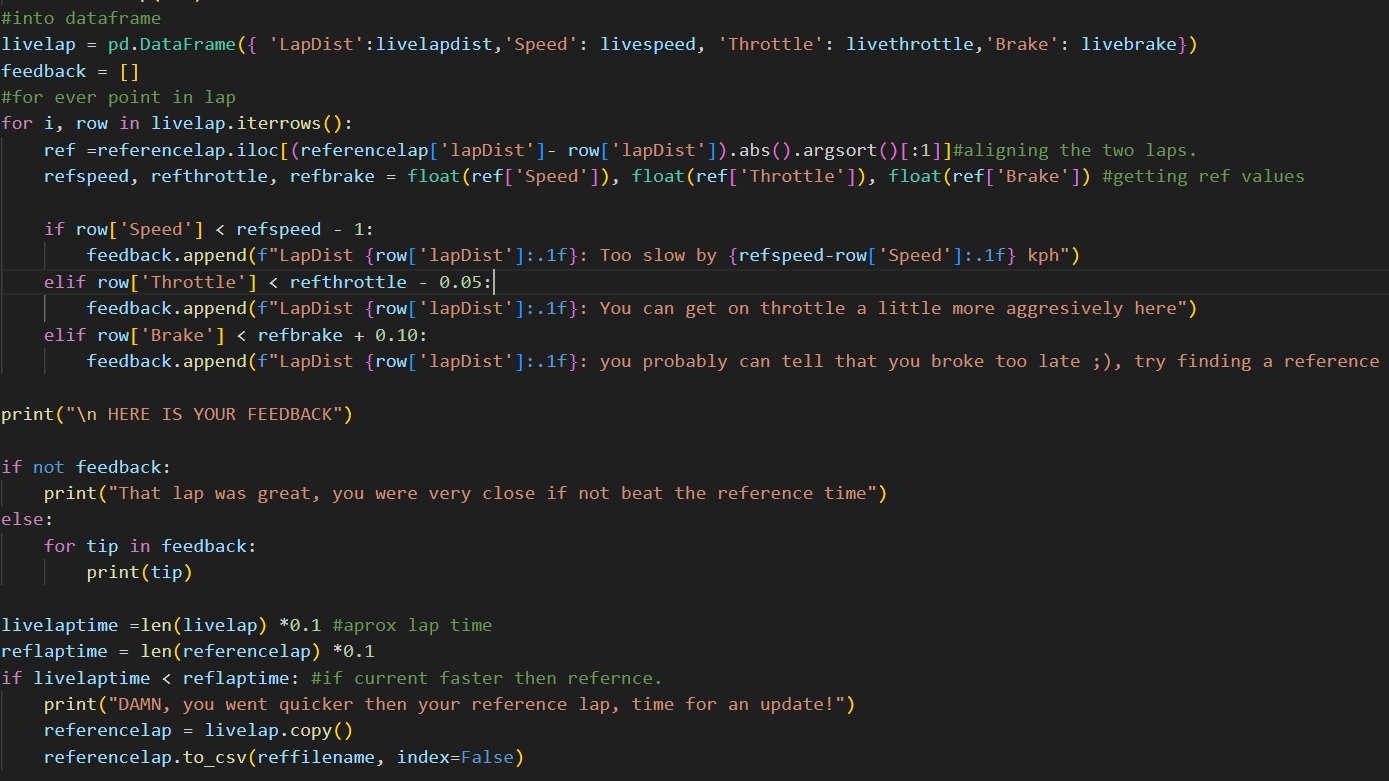
Once the reference lap is saved, the program then records a new “live” lap and compares each moment of that lap to the corresponding point in the reference. Using nearest-distance matching, the tool identifies whether the driver was too slow, too cautious on throttle, or too late on the brakes at any point. Based on these differences, the program outputs clear, actionable feedback designed to help the driver improve consistency, technique, and overall lap time. If the new lap turns out to be faster than the reference, the tool automatically updates the benchmark—creating a dynamic coaching system that evolves with the driver’s performance.
As I wrap up this project, I want to reflect on the process and the results I achieved. Working through each stage—from initial planning to the final analysis—helped me understand not only the content of the topic but also how to manage a full research cycle on my own. I learned how to troubleshoot challenges as they appeared and adjust my approach when something wasn’t working. The project pushed me to think more critically and communicate my ideas with clarity. Looking back, I can see how much I’ve grown in both independence and analytical skill, and these lessons will definitely guide me in future academic work.