VIP Land Speed EV
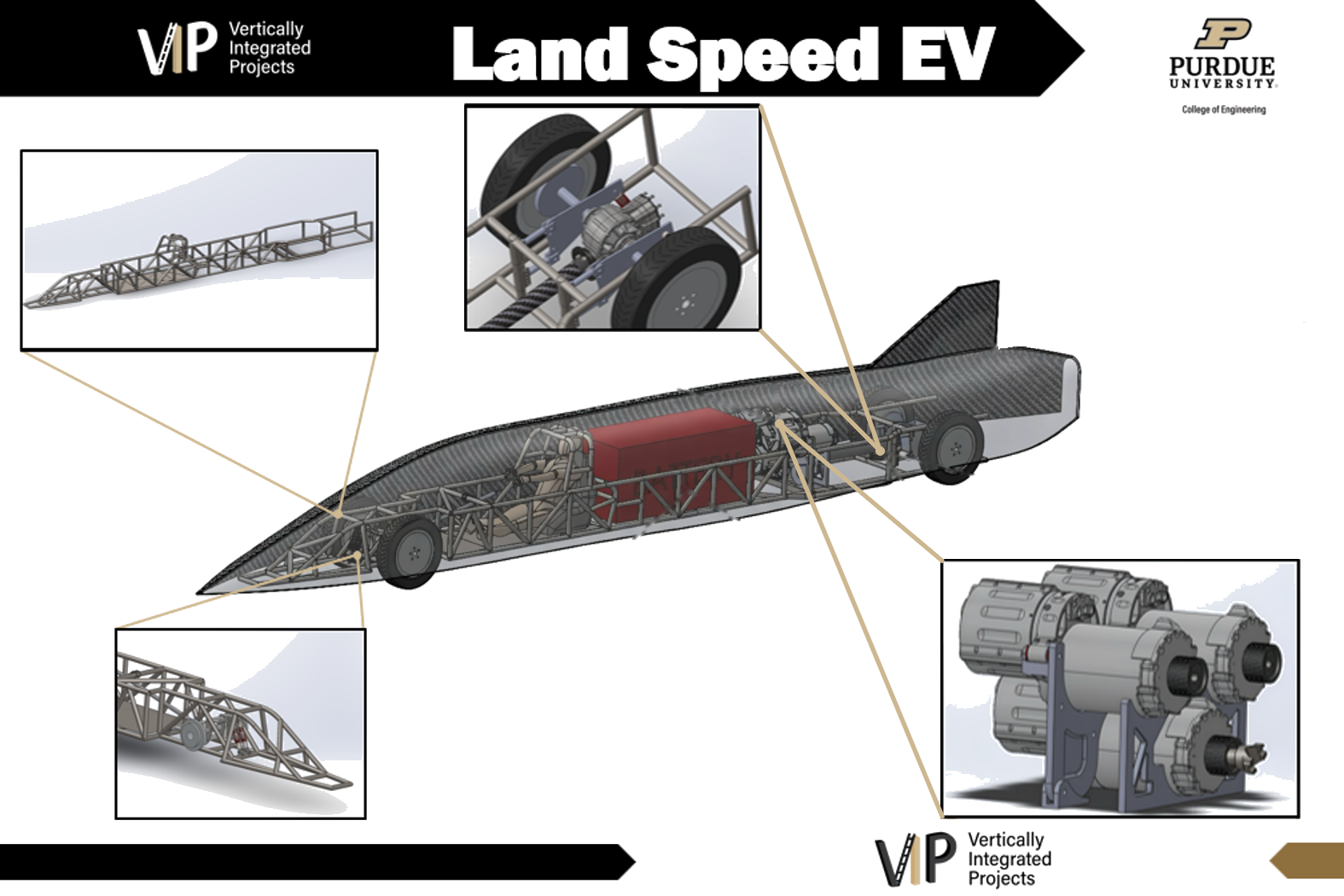
During my second semester I joined the VIP Land Speed EV project, a 20-member group working toward an attempt at the 350+ mph electric land speed record. I worked on the three-person Motors and Controllers team, responsible for how the car makes its power and how it survives putting it down.
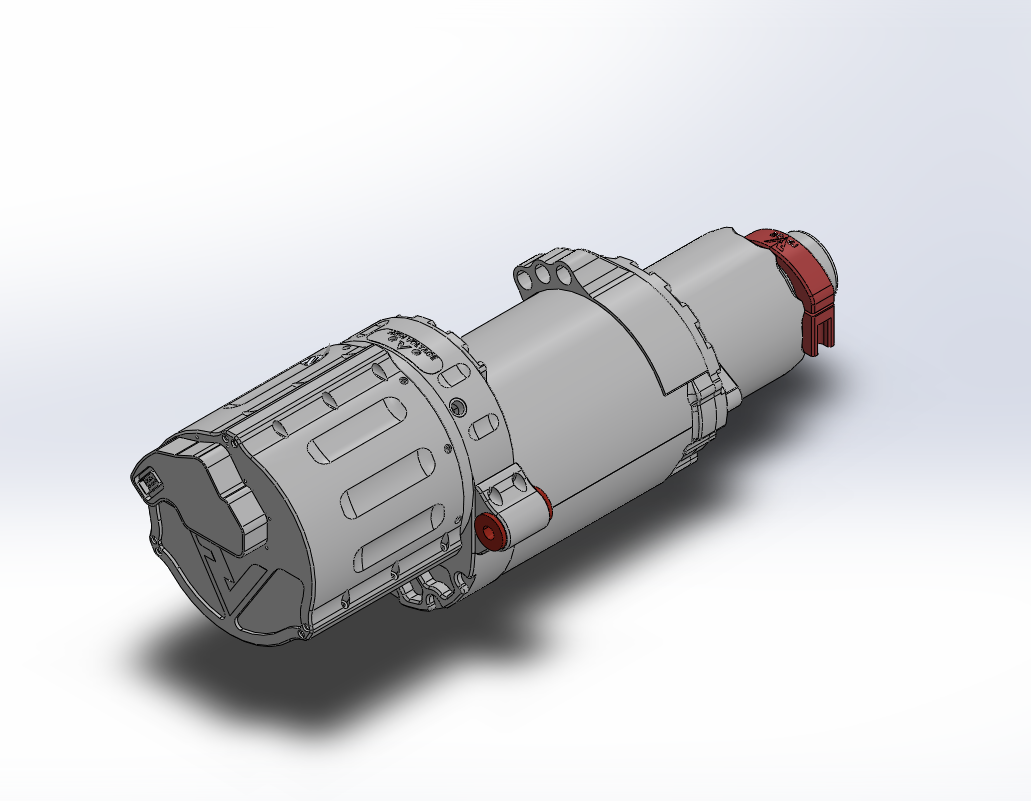
I designed the powertrain layout around three ReVolt Systems motors, spatially packaging them in SolidWorks to fit inside the chassis team’s constraints. Each motor produces roughly 450 kW — about 600 hp — and 800–900 lb-ft at the yoke, giving a theoretical 1.35 MW, around 1,800 hp and 2,550 lb-ft, across all three. I built Excel simulations to project power output and thermal load across a run, mapping the torque curve against its drop-off near 5,500 motor rpm and targeting the 7,000–10,000 rpm band where the motors run near 94% efficiency. That work drove the gearing decision: with a 13.25 inch minimum drop required by the chassis, I compared quick-change drop boxes from Haisley, Winters and SCS before settling on an 18 inch unit for its torque capacity and gear range.
The deeper I got, the clearer it became that this is a thermal problem more than a power problem. Peak output is limited to roughly 320 kW per motor for about 60 seconds before saturation, and a record run is only about 90 seconds long. I researched how previous record cars handled it — the Buckeye Bullet’s closed-loop ice water and chilled transmission fluid, Little Giant’s pre-frozen motors — and worked toward a system that targets the windings, where insulation failure starts, while holding the motors under 130 °C and the battery in its 30–50 °C window. Alongside that I scoped the control side: one controller per motor, communicating over CAN bus, with an ECU balancing torque across all three.